
Getting Your First Eye Prescription: What to Expect
Signs You May Need Vision Correction
Vision changes often develop gradually, making them easy to overlook at first. Knowing what to watch for can help you seek care before symptoms affect your daily life.
When objects across the room look fuzzy, or when you struggle to read text on your phone or printed page, your eyes may be having difficulty focusing light properly. This blurriness can come and go at first, then become more consistent over weeks or months.
Headaches that develop regularly after reading, using a computer, or doing close work can be a sign that your eyes are straining to focus. The muscles around and behind your eyes work harder than they should when your vision is uncorrected.
- Pain that starts behind or around the eyes
- Tension that builds throughout the day
- Relief when you stop and rest your eyes
- Discomfort that happens most days of the week
Squinting briefly changes how light enters your eye, which can temporarily sharpen your vision. If you find yourself squinting to read signs, see the television, or recognize faces across a room, your eyes may be telling you they need help. Similarly, leaning toward your screen or holding reading material very close are common early signs of a vision problem.
Eyes that feel tired, sore, or heavy after reading or screen time are working harder than they should. This fatigue often eases with rest but returns quickly once you resume visual tasks. Some people also notice their eyes feel dry or watery when strained, which can add to discomfort.
Struggling to see road signs in low light, noticing halos or starbursts around oncoming headlights, or feeling less confident driving after dark may all point to an uncorrected vision problem. Night vision difficulties are worth discussing with your eye doctor even if your daytime vision seems acceptable.
- Trouble reading signs in low light conditions
- Halos or glare around lights at night
- Difficulty judging distances between vehicles
- Increased hesitation or anxiety when driving after dark
What Happens During Your First Eye Exam
A comprehensive eye exam does much more than check whether you need glasses. It also evaluates the overall health of your eyes and helps catch early signs of conditions that may not cause noticeable symptoms yet.
We recommend that all adults have a baseline comprehensive eye exam, even if they have never noticed vision trouble. Children should have their first exam around age three, with a follow-up before starting kindergarten. Adults with a family history of eye disease, diabetes, high blood pressure, or significant screen time may need more frequent visits than the general population.
A little preparation makes your visit go more smoothly. Bring any glasses or contact lenses you currently use, even if they are old or from a previous provider.
- Write down symptoms such as headaches, blurry vision, or eye fatigue
- List any medications you take regularly
- Note any family history of eye disease or vision problems
- Plan for about one hour for a thorough exam
- Arrange a ride home in case dilating drops are used
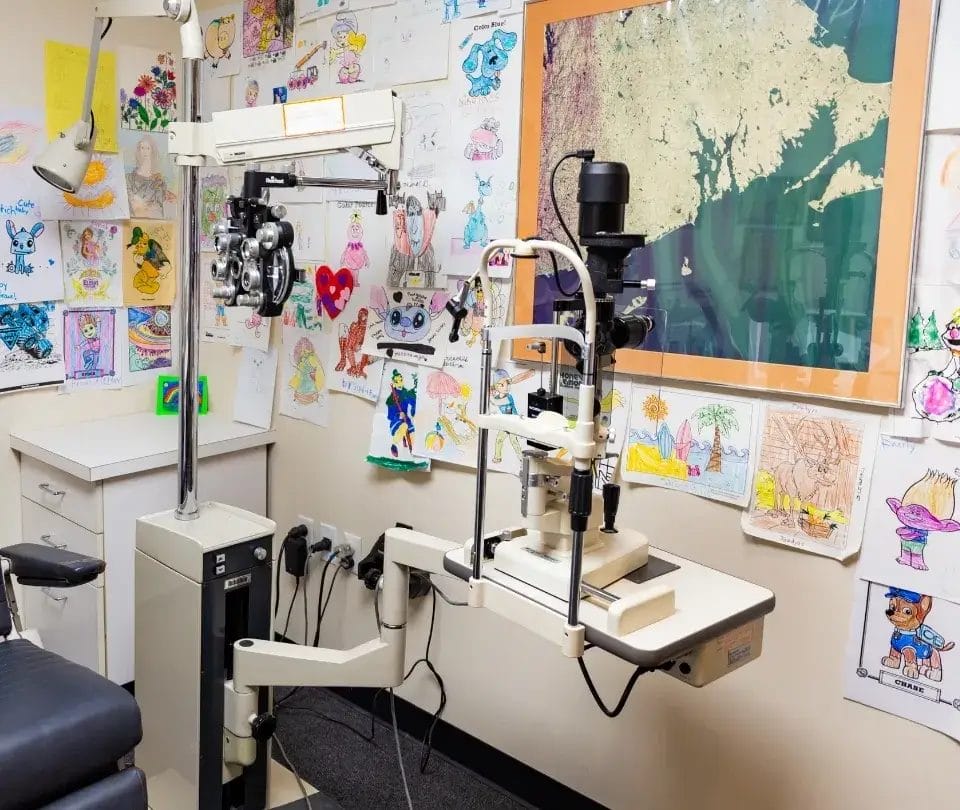
We start by measuring how clearly you see at various distances using an eye chart, covering one eye at a time. Next, we perform a refraction test, where you look through a specialized instrument and compare different lens options. This process helps us determine the precise correction your eyes need.
Beyond measuring your vision, we examine the health of every part of your eye. Using a bright light and a microscope called a slit lamp, we evaluate your cornea (the clear front surface of the eye), your iris, and your lens. We may also use dilating eye drops to widen your pupils so we can examine your retina and optic nerve at the back of the eye. This step can reveal early signs of conditions like glaucoma or macular degeneration before symptoms appear.
After all testing is complete, we explain what we found in plain language and whether you need vision correction. You will leave with a written prescription and a clear understanding of your options.
- Review your exact prescription measurements
- Discuss any eye health findings
- Ask questions about treatment or correction choices
- Receive a written prescription to keep for your records
- Schedule any recommended follow-up appointments
Understanding Your Prescription
Your prescription is filled with numbers and abbreviations that can look confusing at first. Understanding what each value means helps you make informed decisions about your vision care.
OD refers to your right eye, OS refers to your left eye, and OU means both eyes together. These abbreviations come from Latin terms and are standard across all eye prescriptions. Each eye may have different values because it is common for the two eyes to have slightly different prescriptions.
The sphere value tells you whether you are nearsighted or farsighted and how much correction you need. A minus sign means nearsighted, and a plus sign means farsighted. A higher number in either direction indicates a stronger prescription. Cylinder and axis values appear only if you have astigmatism, a condition where the cornea has a slightly uneven curve. The cylinder measures how much astigmatism you have, and the axis describes the angle where correction is needed, expressed in degrees from 1 to 180.
Nearsighted people (myopia) see nearby objects clearly but struggle with distance. Their prescriptions carry negative sphere numbers and require concave lenses that are thinner at the center. Farsighted people (hyperopia) often see distant objects more easily than close ones, though severe farsightedness affects all distances. Their prescriptions show positive sphere numbers and use convex lenses that are thicker in the middle.
Around age 40, most people begin to notice that focusing on close objects becomes more difficult. This is called presbyopia, a natural change that happens as the lens inside the eye gradually loses flexibility over time. If you have presbyopia, your prescription will include an Add power value, which is extra magnification for reading and close tasks. This number is always positive and tends to increase gradually with age.
Prescription strength is generally described as low (plus or minus 0.25 to 2.00), moderate (2.25 to 5.00), or high (above 5.00). These ranges help guide decisions about lens materials and thickness. It is important to know that prescription strength does not directly indicate eye health. Someone with a strong prescription can have completely healthy eyes, while someone with a mild correction may still require monitoring for other conditions.
Choosing Your Vision Correction Options
Once you have a prescription, you have several options for how to correct your vision. The best choice depends on your lifestyle, comfort, and personal preference.
Eyeglasses are often the easiest starting point for first-time prescription wearers. They require no special handling, offer UV protection, and can be removed whenever you need a break. Contact lenses provide a wider field of view and can be more convenient during physical activities, but they require consistent hygiene and proper technique. We often recommend starting with glasses and adding contacts later once you are comfortable with your correction.
Single vision lenses have the same prescription power across the entire lens and work well for people who need correction at one specific distance. Bifocals have two distinct zones separated by a visible line, one for distance and one for reading. Progressive lenses offer a smooth, seamless transition between multiple viewing distances without a visible line, making them a popular choice for people who need correction at all ranges.
- Single vision lenses are the simplest and most affordable option
- Bifocals work well for straightforward distance and reading needs
- Progressives suit people who need clear vision at many distances
- Our team will help you choose based on your daily activities
Standard plastic lenses work well for mild prescriptions, while high-index materials make stronger prescriptions thinner and lighter. Polycarbonate lenses are impact-resistant and a good choice for children or active adults. Coatings can enhance your lenses significantly. Anti-reflective coating reduces glare from screens and headlights, scratch-resistant coating extends the life of your lenses, and UV-blocking coatings protect your eyes from sun exposure.
If you play sports or work in a physically demanding environment, we can help you find prescription lenses designed for those situations. Impact-resistant polycarbonate lenses with wraparound frames or sports goggles provide both vision correction and eye protection. For those who spend many hours at a computer, we can discuss lens options optimized for screen distance, which may help reduce visual fatigue during extended work sessions.

Adjusting to Your New Glasses or Contacts
Most people need a short period of adjustment when they start wearing a new prescription for the first time. Knowing what is normal helps you feel confident during this transition.
When you first put on prescription glasses, things may look sharper but slightly different than you expect. Your brain needs a few days to adjust to the corrected input, especially if your prescription is moderate or strong. Mild depth perception changes, brief dizziness when turning your head, and awareness of the frames in your peripheral vision are all normal during the first three to five days.
We provide hands-on contact lens training during your fitting appointment and will not send you home until you feel confident inserting and removing your lenses on your own. Proper hygiene is essential for keeping your eyes healthy while wearing contacts.
- Always wash and thoroughly dry your hands before handling lenses
- Use only fresh lens solution each time, never reuse old solution
- Never rinse lenses with tap water
- Replace your lens case every three months
- Follow the wearing and replacement schedule we recommend
Slight edge blur, a brief awareness of your glasses, and minor visual adjustments when switching focus are all expected during the first week. However, some symptoms should not be ignored. Persistent headaches that worsen while wearing your glasses, vision that remains blurry or distorted after a full week of wear, eye pain, or the feeling that one eye is working harder than the other are all reasons to contact us for a follow-up evaluation.
Proper daily care keeps your lenses clear and extends their life. Clean your glasses with lens solution and a microfiber cloth rather than paper towels or household cleaners, which can scratch or strip protective coatings.
- Store glasses in a protective case when not in use
- Use both hands when removing glasses to prevent frame bending
- Keep glasses away from extreme heat sources
- Bring your glasses to our office for professional frame adjustments
When to Schedule Follow-Up Care
Ongoing care is an important part of maintaining both clear vision and long-term eye health. Knowing when to return helps you stay ahead of changes before they affect your daily life.
Adults under 60 with stable prescriptions often do well with a comprehensive eye exam every two years. Adults over 60, or those with health conditions such as diabetes or high blood pressure, should have annual exams to monitor for age-related eye changes. Children and teenagers often need yearly exams because prescriptions can shift quickly during growth periods.
Because contact lenses sit directly on the surface of your eye, they require annual checkups even if your vision feels fine. We check the fit of your lenses and look for any early signs of irritation or corneal changes that can develop over time. First-time contact lens wearers often benefit from a follow-up visit within the first month to confirm proper fit and address any concerns.
Do not wait for your scheduled exam if your current glasses or contacts no longer provide clear vision. Prescription changes can happen at any time, often influenced by age, health changes, new medications, or hormonal shifts such as pregnancy.
- Returning blur or difficulty seeing clearly with current correction
- New or worsening headaches during visual tasks
- Increased squinting even while wearing glasses or contacts
- Eye strain that had previously resolved
- A consistent feeling that your current lenses are too weak
Certain vision changes should never wait for a scheduled appointment. Sudden vision loss, new floaters or flashes of light, a curtain or shadow blocking part of your vision, severe eye pain, or any eye injury requires same-day evaluation. If our office is unavailable, go directly to an emergency room. These symptoms can indicate serious conditions where time matters.
Frequently Asked Questions
These answers address common concerns that come up after a first prescription, offering practical guidance to help you move forward with confidence.
Whether you need full-time wear depends on both your prescription strength and the demands of your daily tasks. People with moderate to strong prescriptions generally benefit from wearing glasses throughout the day, especially for activities like driving where clear vision affects safety. If your prescription is mild, you may only need glasses for specific situations. Either way, wearing your glasses will not weaken your eyes or create dependency. You can put them on and take them off based on your needs without any concern.
Alternating between glasses and contacts is very common and works well for most people. We recommend keeping an up-to-date pair of glasses even if you primarily wear contacts, both to give your eyes regular breaks from lens wear and to have a reliable backup. One thing to be aware of is that your contact lens prescription may differ slightly from your glasses prescription. This is because contacts sit directly on the eye rather than at a distance from it, and we account for that difference when writing each prescription.
Not at all. Nearsightedness, farsightedness, and astigmatism are refractive errors, meaning they reflect the physical shape of your eye rather than a disease or damage. Many people with strong prescriptions have completely healthy eyes. During your comprehensive exam, we evaluate both your visual sharpness and the structural health of your eyes separately, so you receive a complete picture of your eye health regardless of whether you need corrective lenses.
Prescription stability varies widely between individuals. Children and teenagers tend to see more frequent changes as their eyes grow, sometimes yearly. Adults often experience smaller shifts every few years, and many maintain the same prescription for extended periods. After age 40, presbyopia tends to progress gradually, often requiring reading prescription updates every two to three years until around age 60. Factors like changes in overall health, certain medications, and pregnancy can all influence how your prescription shifts over time, which is one reason consistent follow-up care is valuable.
Many children between the ages of eight and twelve are fully capable of wearing contact lenses safely if they demonstrate consistent responsibility with hygiene and care routines. Readiness is more about maturity than age. We evaluate each young patient individually to determine whether they are prepared for the commitment contact lenses require. Daily disposable contacts are often a good starting point for younger wearers because they eliminate the need for daily cleaning solutions and reduce the risk of build-up related problems. We provide additional training and close follow-up to support both children and their parents through the process.
Eye exercises cannot change the physical shape of your eye or eliminate a refractive error. Wearing the correct prescription is actually beneficial, as it reduces strain and allows your visual system to function more efficiently. The most effective steps you can take for long-term eye health are attending regular comprehensive exams, wearing UV-protective sunglasses outdoors, managing systemic health conditions like blood sugar and blood pressure, and following the care plan our team develops for you. These habits support overall eye health even though they do not remove the underlying need for correction.
See Clearly with the Right Care and Guidance
At Rhode Island Eye Institute, our team is here to support you at every stage of your vision journey, from your very first exam to years of ongoing care. We take the time to explain your prescription, answer your questions honestly, and help you find the correction that fits your life comfortably. With fellowship-trained specialists and a dedicated optometry team all under one roof, patients across Rhode Island have trusted us to protect their vision and their eye health for the long term. We look forward to welcoming you to our practice and helping you see your best.